

| Preview | Description
  | Artist | Notes |
|---|---|---|---|
 | Lewis Morris by John Wollaston ca. 1750 Smithsonian Institution New York, NY | Wollaston, John |  Description: Portrait of Lewis Morris standing with his body turned to the right and his head turned to face the viewer. He wears a dark jacket and a light vest with a white shirt. |
 | Lucretia Coffin Mott by Joseph Kyle 1842 Smithsonian Institution New York, NY | Kyle, Joseph | Description: Portrait of Lucretia Mott seated with her body turned to the left, her gaze directed off to the left, and her arms folded across her chest. She wears a lace cap and around her shoulders she wears a shaw over her dark dress. |
 | Margaret Brown Stone by Robert Edge Pine c. 1785 Smithsonian Institution New York, NY | Pine, Robert Edge | |
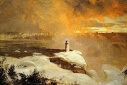 | Niagara Falls by Frederic Edwin Church March 1856. Smithsonian Institution New York, NY | Church, Frederic Edwin | |
 | Patience Lovell Wright by Robert Edge Pine oil on canvas Smithsonian Institution New York, NY | Pine, Robert Edge | Patience Wright, a Quaker widow from Bordentown New Jersey, looked to support her children by modeling in wax to produce lifelike figures of celebrities, exhibiting them with success in Philadelphia and New York. After a fire destroyed much of her collection, she went to England in 1772, where her artistic skill and engaging bluntness won her a... |
 | Portrait of a Girl by Thomas Wilmer Dewing 1905 Smithsonian Institution New York, NY | Dewing, Thomas Wilmer | |
 | Robert Morris by Robert Edge Pine c. 1785 Smithsonian Institution New York, NY | Pine, Robert Edge | As the Second Continental Congress moved toward a vote for independence, Robert Morris, one of America's leading merchants, thought that the country was not ready for it. In the interest of colonial unity, Morris absented himself from the Pennsylvania delegation when the vote was taken on July 2, but added his signature to the embossed copy of the... |
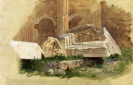 | Ruins of the Temple of Buccus, Baalbek, Syria by Frederic Edwin Church 1868. Smithsonian Institution New York, NY | Church, Frederic Edwin | |
 | Salmon Portland Chase by Francis B. Carpenter 1861. Smithsonian Institution New York, NY | Carpenter, Francis B. | |
 | Self-portrait, 1894 by Cecilia Beaux 1894 Smithsonian Institution New York, NY | Beaux, Cecilia |
- Smithsonian Institution

