

| Preview | Description | Artist
  | Notes |
|---|---|---|---|
 | Peter Boylston Adams by John Singleton Copley ca. 1765-1770 Smithsonian American Art Museum Washington, D.C. | Copley, John Singleton |  This miniature is thought to show Peter Boylston Adams, who was born in Norfolk, Massachusetts, in 1738. Peter was the brother of the second president of the United States, John Adams, and a captain in the Revolutionary War. He married Mary Crosby in 1768, and this miniature may have been painted to commemorate their wedding. |
 | Mrs. George Watson by John Singleton Copley 1765 Smithsonian American Art Museum Washington, D.C. | Copley, John Singleton | Mrs. Watson, the wife of a wealthy Boston merchant, wears a fashionably low-cut gown of luscious satin and white lace and holds a porcelain vase that echoes the contours of her figure. The yards of expensive fabric and silk ribbons in the costume testified to George Watson's success as an importer of European goods, as did the fact that he could... |
 | Robert Hooper by John Singleton Copley ca. 1770-1772 Smithsonian American Art Museum Washington, D.C. | Copley, John Singleton | Mr. Hooper was the son of Robert King Hooper, who owned a fishing fleet that worked out of Marblehead, Massachusetts. The younger man already sports the rotund physique that Copley had captured in a portrait of Hooper's father years earlier. Behind him, the sea, visible through an open window, recalls the source of his family’s riches. Robert had... |
 | Elk-Foot of the Taos Tribe by Eanger Irving Couse 1909 Smithsonian American Art Museum Washington, D.C. | Couse, Eanger Irving | |
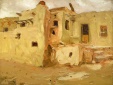 | Walpi Pueblo by Eanger Irving Couse 1903 Smithsonian American Art Museum Washington, D.C. | Couse, Eanger Irving | Eanger Irving Couse painted this scene one year after his first trip to Taos. Like other eastern artists, he was especially struck by the intense light and stark contrasts of northern New Mexico. Couse painted Walpi Pueblo as a quick sketch, capturing the sudden, lonely chill that accompanies the clouds at higher elevations. |
 | A Lady in Black by Kenyon Cox 1880 Smithsonian American Art Museum Washington, D.C. | Cox, Kenyon | This is a portrait of the wife of Kenyon Cox’s friend the painter Lowell Dyer. In 1880, Cox exhibited the painting in Philadelphia, and also entered it in a Paris show under the French title Dame en noir. This masterful portrait sketch focuses our eyes on Mrs. Dyer’s spirited expression and tilt of the head. Cox’s fast brushwork gives the... |
 | After Boltraffio, "Sacre Conversazione" by Kenyon Cox 1878-1882 Smithsonian American Art Museum Washington, D.C. | Cox, Kenyon | d surrounded by saints. Boltraffio's version depicts the Virgin and child with John the Baptist, Saint Sebastian, and the patrons of the painting, Giacomo Marchione de Pandolfi da Casio and his son Girolamo Casio. |
 | After Titian's "Madonna of the Rabbit" by Kenyon Cox 1878-1882 Smithsonian American Art Museum Washington, D.C. | Cox, Kenyon | Kenyon Cox painted this small, sketchlike image while studying in Paris. Although Cox trained with well-known French artists, his works were largely influenced by Greek, Roman, and Renaissance art. After Titian's "Madonna of the Rabbit" is a copy of a painting in the Louvre by Italian Renaissance artist Titian (about 1490-1576). The triangular... |
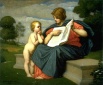 | Book of Pictures by Kenyon Cox 1910-1917 Smithsonian American Art Museum Washington, D.C. | Cox, Kenyon | using such means to encourage lessons of good taste that would extend into all aspects of American life. |
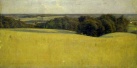 | Lengthening Shadows by Kenyon Cox 1888 Smithsonian American Art Museum Washington, D.C. | Cox, Kenyon | d the long shadows suggest it was painted at dusk, just before the sun completely disappeared over the horizon. |
- Smithsonian American Art Museum

