

| Preview | Description | Notes
  | Content | Updated by |
|---|---|---|---|---|
 | A Vision of the Past 1913 Butler Institute of American Art Youngstown, OH |  In "A Vision of the Past", Couse contrasted the past and present, suggesting that the future held little promise for tribal culture. In doing so, he contributed to a tradition of imagery first popular in the 1830s, that of the vanishing race of "doomed" Native Americans. | GA | Anonymous |
 | Chief Shoppenegons 1910 Detroit Institute of Arts Detroit, MI | GA | Anonymous | |
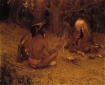 | The Peace Pipe c. 1902 Metropolitan Museum of Art New York, NY | GA | Anonymous | |
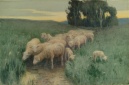 | At the Spring (Sheep in field) Early 20th Century Brigham Young University, Museum of Fine Arts Provo, UT | GA | Anonymous | |
 | Boat Alone #1 Early 20th Century Brigham Young University, Museum of Fine Arts Provo, UT | GA | Anonymous | |
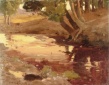 | Brook with Wooded Area 1903-1905 ca. Brigham Young University, Museum of Fine Arts Provo, UT | GA | Anonymous | |
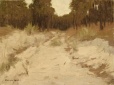 | Clearing 1891-1904 ca. Brigham Young University, Museum of Fine Arts Provo, UT | GA | Anonymous | |
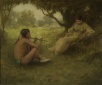 | Lovers (Indian Love Song) 1905 Brooklyn Museum New York, NY | ian art. Owing in part to the appeal of such images, they traveled in growing numbers to Taos, New Mexico, where Couse spent a portion of each year beginning in 1902. | GA | Anonymous |
 | Sacred Waters oil on canvas Indianapolis Museum of Art Indianapolis, IN | Couse is best known for his intimate images of Native Americans in quiet repose. The artist's paint strokes set up a rhythmic flow, which moves throughout the work. Tradition holds that the Taos Indians were created out of the sacred waters of Blue Lake. | GA | Anonymous |
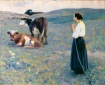 | The Cowherd (La Gardeuse de Vaches) 1895 Joslyn Art Museum Omaha, NE | GA | Anonymous |
- Eanger Irving Couse

